
EARLY SYNTHESIS OF FILLA'S CUBIST THINKING
At the 94th Auction of Galerie KODL, an exceptional painting by Emil Filla, Samovar, will be auctioned — a work belonging to the rarest examples of his early Cubist period. The painting, inaccessible to the public for many years, represents an important link in understanding Filla’s formal transformation in the years 1912–1913.
Context and Genesis of the Work
The months around 1913 were a period of intense experiments and re-evaluation of pictorial language in Filla’s work. Filla repeatedly stayed in Paris, where he directly followed the latest developments of Cubism and intensely studied the works of Pablo Picasso and Georges Braque. Besides his honeymoon with his wife Hana, a total of four journeys between 1912–1913 are documented, and only the outbreak of the First World War prevented him from moving there permanently. Samovar stands at the boundary between Filla’s earlier monochrome Cubism and his newly acquired conviction about the need to synthesize form and color.
While in 1912 Filla worked with a sparse, even ascetic range of ochre and brown tones, works from the following year already show a more pronounced use of color and a clearer sense of constructive confidence. It is Samovar that exemplarily demonstrates this transformation.
Formal and Technical Construction
The painting is built upon a combination of materials — oil, enamel, and sand texture — which Filla used at a time when Czech modern painting was only beginning to acquaint itself with similar procedures. The industrial enamel of the Ripolin brand, with which Filla came into contact in Picasso’s studio, lends selected areas an unusual sheen and material density, while the incorporation of fine sand into the paint creates a surface roughness and a vibration of light.
The composition is tightly bound into a vertical axis formed by a blue enamel area, which is not only a color accent but also the structural pillar of the entire painting. From individually, disciplined-ly arranged planes grows an abstract architecture of the motif, oscillating between Cubist reduction and monumental calm.
Large black planes, which Filla liked to employ throughout his entire oeuvre, act here as a stabilizing element: they ground the overall color scheme and at the same time create a contrast to the more lightly handled central area. Thus the painting acquires a firm rhythm and dynamism without the need to disrupt its fundamental construction.
The Motif of the Samovar in Cubist Transformation
The samovar — a traditional everyday object associated with the culture of dining and rituals of hospitality — is here entirely severed from its functional and material reality. Filla transforms it into an artistic problem: not the description of the object, but the manner of its construction and its role within the pictorial surface is what truly interested him. The object thus became a bearer of geometric expression rather than iconographic meaning.
Significance Within Filla’s Early Cubist Phase
Samovar represents one of the first fully synthesized compositions in which Filla inclines neither toward analytical fragmentation of form nor to mere imitation of Parisian models. The painting demonstrates the artist’s ability to adapt Cubism into his own markedly personal pictorial language — solid, monumental, and technically considered.
In the scholarly context, the work is a valuable material for tracing Filla’s developmental trajectory. It belongs among the paintings that anticipate the later synthetic character of his work while also documenting one of the most vibrant phases of the Czech avant-garde.
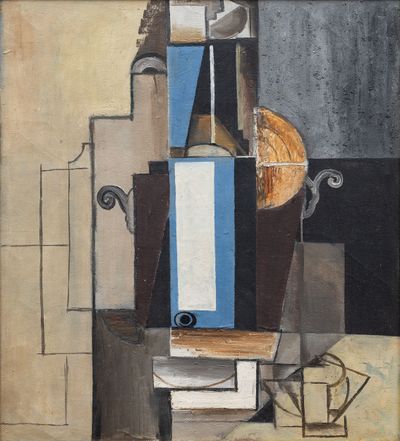
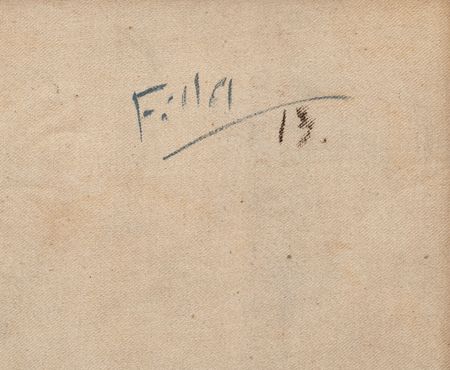
Samovar, 1913; signed on the reverse; oil, enamel and sand on canvas; 52 × 47 cm
